Symposium: Naar een meer inclusieve economische- en bedrijfsgeschiedenis
Organisatie
Nederlandsch Economisch-Historisch Archief (NEHA)
Stichting Bedrijfsgeschiedenis (SBG)
Internationaal Instituut voor Sociale Geschiedenis (IISG)
Over
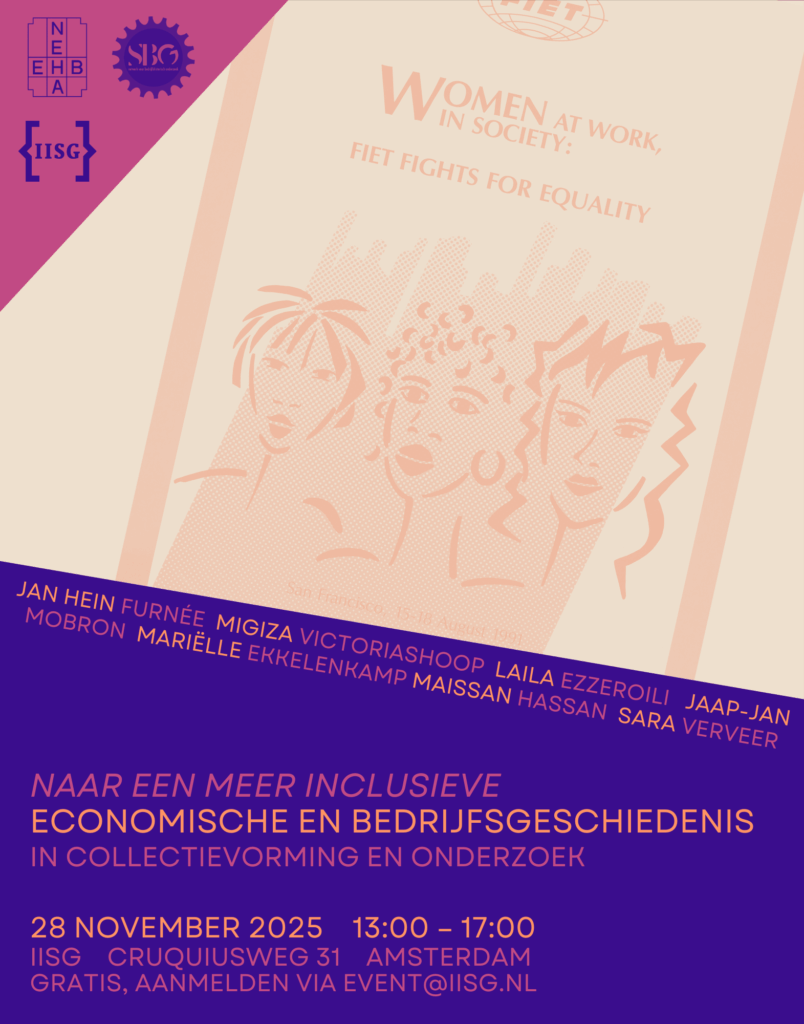
In dit symposium wordt gekeken naar de veranderende betekenis van het begrip inclusiviteit en wat dat betekent voor de historische verhalen over gemarginaliseerde groepen, zowel in onderzoek als in archiefvorming en collectiebeheer. Het symposium wordt georganiseerd door het Nederlandsch Economisch-Historisch Archief, Stichting Bedrijfsgeschiedenis en het IISG.
Inclusiviteit heeft verschillende betekenissen, die in de loop der tijd zijn veranderen. Dit heeft gevolgen voor de wijze waarop over verschillende groepen wordt geschreven, bijvoorbeeld binnen de economische en bedrijfsgeschiedenis. Zo wordt in recent onderzoek de economische bijdrage van vrouwen veel breder opgevat, met aandacht voor hun rol als ondernemer, investeerder en uitvinder.
In dit symposium komt zowel het perspectief vanuit onderzoek als collectievorming aan bod. Wat betreft onderzoek ligt de nadruk op het selecteren van bronnen, de formulering van onderzoeksvragen en de manier waarop geschiedenis wordt geschreven. Wat betreft collectievorming staan vragen centraal als: wie bepaalt wat wordt verzameld, vastgelegd en bewaard? Welke bronnen zijn beschikbaar? En hoe beïnvloeden deze keuzes de verhalen die worden verteld over onder meer vrouwen, migranten, gemarginaliseerde groepen, mensen met een beperking en verschillende sociale klassen?
De aandacht gaat daarnaast uit naar inclusieve collectievorming binnen de economische en bedrijfsgeschiedenis. Zo worden onder andere veranderingen in terminologie, onderzoeksperspectieven, betrokken groepen en het gebruik van diverse typen bronnen besproken. Dit symposium wil bijdragen aan kennisdeling en een breed en inclusief dialoog tussen academici, onderzoeksinstellingen, archieven en bedrijven.
Programma
13.00 – 13.30 uur | Inloop
13.30 – 13.45 uur | Welkom en opening
Introductie van het programma en toelichting op het thema
13.45 – 14.30 uur | Publiekslezing – Uitsluitend inclusief? Blinde vlekken in historisch onderzoek en collectievorming Jan Hein Furnée (hoogleraar Cultuurgeschiedenis Radboud Universiteit & voorzitter Koninklijk Nederlands Historisch Genootschap)
14.30 – 14.45 uur | Pauze
14.45 – 15.30 uur | Bronnentafels – Nieuwe perspectieven en onderzoeksvragen
Interactieve sessie met voorbeeldcollecties en gesprek over hoe deze nieuwe vragen kunnen oproepen. De volgende instellingen en personen zijn aanwezig: ABN AMRO – Jaap-Jan Mobron, IISG – Maissan Hassan & Sara Verveer, Stadsarchief Amsterdam – Migiza Victoriashoop & Laila Ezzeroili en Universiteit van Amsterdam – Mariëlle Ekkelenkamp
15.30 – 16.00 uur | Slotdiscussie – Naar een inclusiever verzamelbeleid
Discussie met alle aanwezigen uit wetenschap, archiefvorming en bedrijfswereld over de vraag hoe we nu al bewuste keuzes kunnen maken voor een inclusievere geschiedschrijving in de toekomst.
16.00 – 17.00 uur | Borrel
Praktisch
Datum 28 november 2025
Tijd 13:00 – 17:00
Plaats IISG Cruquiusweg 31, 1019 AT Amsterdam
Toegang is gratis, maar vanwege de organisatie graag aanmelden via event@iisg.nl
Het IISG is rolstoeltoegankelijk.
___________________________________________________________________________________________________
Call for Papers!
From Insurance to Chartered Companies: New developments in the history of business, slavery, and colonialism
Deadline call for papers: 15 april 2025
Workshop at 21 November 2025, IISH, Cruquiusweg 31 Amsterdam.
The NEHA board is proud to announce their participation in funding this workshop on the history of slavery and colonialism.
Workshop
Recent years have seen the proliferation of projects dealing with topics that broadly fit the category of business history of slavery and colonialism. Not only well-established scholars, but many young researchers are picking up projects in this field. Yet because of the broad demarcations of, and interest in, the topic remains divided along disciplinary and geographical lines. We intend to organize a workshop for early-career researchers to explore new perspectives on business history in relation to the histories of slavery and colonialism. This workshop will provide extensive peer discussion and feedback from senior experts in the field. The workshop aims to encourage and strengthen ties among early-career researchers in the field of business history.
The event will be hosted by the International Institute for Social History in Amsterdam on Thursday and Friday 20-21 November, 2025.
The focus of the two-day workshop will be on the current state of the field of business history. Emerging research is broadening the scope, integrating methods and insights from social, economic, and business histories. Considering this, the aim of the workshop is to focus on how these new developments, combining various perspectives, can be employed to further enhance our understanding of colonialism and slavery. We widely define business histories -(families, merchants, trading houses, firms, financial institutions, e.g. insurance companies).
Contributions are encouraged from anyone working on a related topic, even if you do not consider yourself formally to be a business historian. The point is exactly to cross pre-conceptualized sub-disciplinary lines.
The workshop will focus on several key theoretical, empirical, and methodological questions:
- Which tools and strategies did businesses use to shape slavery and slave trading?
- How did businesses navigate financial challenges? What were the aims of business beyond the wish to produce profit (political and social)?
- How can we employ business archives to integrate the experience of enslaved people in such studies?
- How were activities shaped not only by boards and executives, but workers, lower officials and colonial populations?
- How can we systematically research or measure the impact of business practices on the lives and labor conditions of colonial subjects?
- What challenges exist in using business records as sources of colonial history and how can we attempt to resolve these?
This workshop is especially aimed at early-career researchers – PhD candidates and postdocs. Anyone working on these topics, regardless of time period and geographical focus, is welcome to apply. We encourage especially those in intermediate or later stages of their research, meaning we expect you to be able to present an early or later draft of an article or book chapter (max. 10,000 words), rather than a wider project overview.
If you are interested in participating in the workshop, please send an abstract (max. 500 words) to the organizers (eva.seuntjens@iisg.nl and bart.van.holsteijn@gu.se) before 15 April, 2025. Limited travel support might be available for those without institutional backing.